
Wi-Fi in the UK is currently delivered over two public Radio Frequency (RF) bands, the 2.4GHz band and the 5GHz band.
For various reasons, the 5GHz band generally provides better performance than the 2.4GHz band.
On the 2.4GHz band there are 11 centre frequencies (spaced at 5MHz intervals) that are recognised in all countries to support 20MHz-wide channels.
Although some additional frequencies are allowed in most countries, we generally stick to these frequencies so that devices from all countries will work with them.
The 2.4GHz band is generally only wide enough therefore for 3 completely discrete 20MHz-wide Wi-Fi channels (centred around frequencies 1, 6 and 11). Whilst it is possible to bond two 20MHz-wide channels together to create a 40MHz-wide channel, there are not enough channels within the 2.4GHz band to create more than one 40MHz-wide channel, so we are stuck with the 3 × 20MHz-wide channels in an institutional setting, because our objective is to operate as many channels as possible to minimise interference and increase performance. This channel limitation is therefore one of the key limitations of the 2.4GHz band.
Another limitation of the 2.4GHz band is that it is used by more 'non-WiFi' devices than the 5Ghz band, Bluetooth® is an example of this.
The chart below shows actual traffic seen on the 2.4GHz band during a survey. The individual 5MHz-wide frequencies are shown on the x-axis, and the received power is shown on the y-axis. The black envelopes depict Wi-Fi channels in operation.
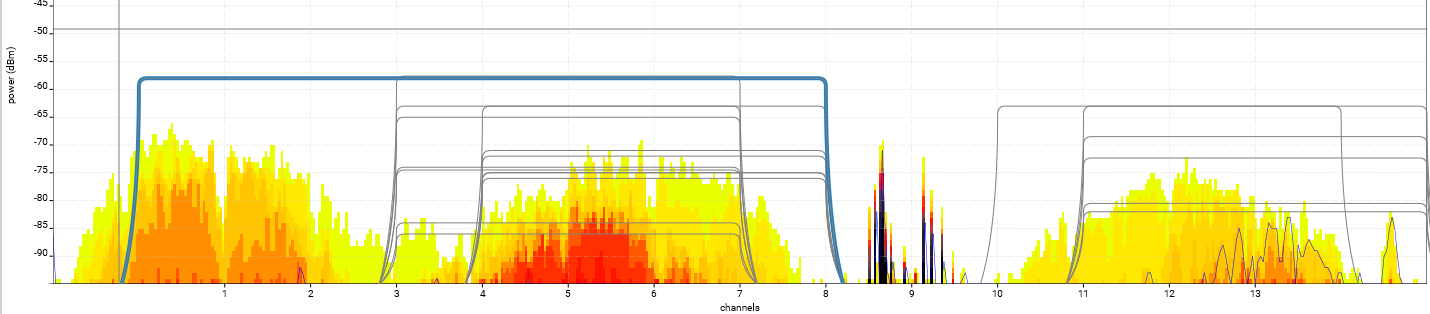
We see a rogue 40MHz-wide Wi-Fi channel (highlighted in blue), that is using up 8 of the 11 5MHz frequencies.
Assuming an interference threshold of -86dBm, then there are also an additional 7 active APs with 20MHz-channels configured on channel 5 (not 6), and 5 active APs with 20MHz-channels configured on channel 6.
In total the cells from 13 different APs/radios are overlapping, and so all of the Wi-Fi devices in all of these cells have to share the available bandwidth.
The Wi-Fi standard does have flow control protocol and back-off mechanisms to manage media contention. But the protocol in particular relies on signals being received clearly on the same (or a nearby) channel. If there is too much interference, then the flow control protocol will not work, and the back-off mechanisms introduce delays to avoid messages colliding on the air.
In this example, we also see lots of specific frequencies around channel 9, which are used in a 'radar'-type fashion by automated lights to detect motion. These will cause interference on a 20MHz-wide channel centred on frequency 11.
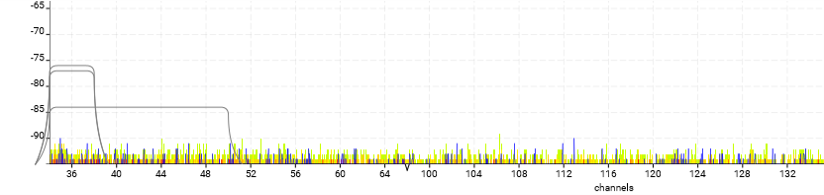
By comparison, the 5GHz band can be a lot quieter. Here is a sample of a portion of the 5GHz band taken during a similar survey. The centre frequencies are also listed at 5MHz intervals.
When the signal from the 2.4GHz radios on the APs is turned down, so that the signal from the 5GHz radios on the APs is seen by clients to be 6dB stronger, then the client devices will more likely connect to the 5GHz radio, which will generally improve performance.
For this reason, the corresponding power of 2.4GHz radios is usually turned down.
