
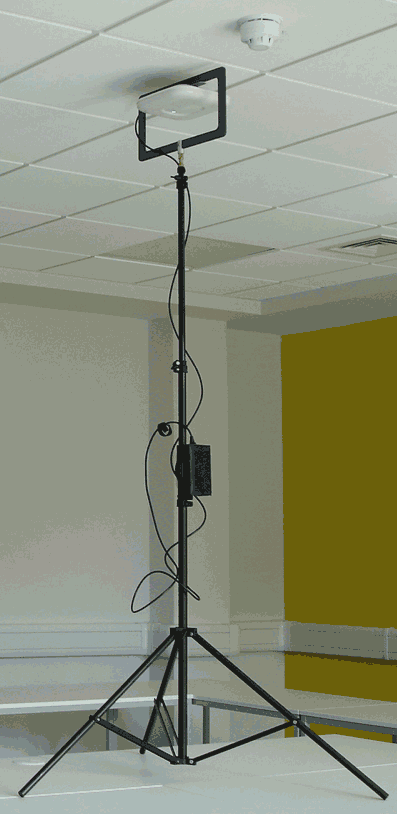
We use multiple tripods for our APoaS measurements, because they allow us to:
- test more, more quickly
- test to the boundary of the AP cell, which can cause contention/interference, which tends to extend a long way at a power of about -85dBm
- test client roaming performance, and test client throughput whilst roaming.
When we do a Wi-Fi Design we follow our Wi-Fi Design Methodology and the best practice that we have laid out in our technical design articles.
Depending on the purpose of the health check, a number of different tests can be performed.
- An assessment of the Wi-Fi performance with respect to utilisation, channel and protocol stats., using monitoring tools and/or protocol analysis as necessary.
- A check on the network health of Wi-Fi client devices/applications reported by system statistics, the client device, our client performance monitoring App., or protocol analysis as necessary.
- An assessment of the RF environment to determine sources of interference and rogue Wi-Fi devices not part of this Wi-Fi system.
- Checks on the Wi-Fi system configuration and an RF survey of the APs taken in the context of this Wi-Fi configuration, to determine whether they are providing adequate and separate cells to deliver the required service for client devices and their applications.
- Client throughput testing and/or roaming and/or protocol analysis to determine the underlying performance of client Wi-Fi connections.
- Protocol analysis to determine the details behind particular problems to be diagnosed.
- An audit of cabling, hardware and software as required.
We will consult fully around the design requirements for your Wi-Fi and devise a design specification, to accommodate your end-user devices and the applications to be deployed. We can also assess your existing cabling infrastructure, as well as any physical limitations that may prevent APs from being installed in their optimum positions. Based on this specification and any agreed limitations, we will place APs powered by batteries/antennas to meet these requirements using one or more tripods, and take measurements to confirm that in each position, the RF constraints imposed by the built environment will meet the design specification, as well as preventing or at least limiting the extent of any interference that may affect neighbouring cells. We will also be able to test roaming behaviour and throughput, to achieve the required performance/capacity for the design. We will then fully document our recommended design, together with the survey results compared with the design criteria and the recommended configuration for the deployed Wi-Fi system required to deliver reliable Wi-Fi, prior to installation.
Whilst a thorough survey is always recommended because hidden elements of a building's construction may change and this will impact the Wi-Fi, it is possible to reduce the design cost by making some assumptions. The design time can be reduced by building an electronic model of the way Wi-Fi might work in the building, based on fewer readings. This may work well if a building has several floors of the same construction, so a good model of the behaviour of Wi-Fi on other floors can be modelled instead of surveyed and it may be necessary if some of rooms of a building were inaccessible at the time of the survey. It is called a hybrid design because it is a model based on some actual readings.
It is a trade-off because the design will only be as good as the quantity of readings that are taken, any likely variance between these reading in reality due to real-world RF effects, and the quality of the modelling tool itself. For example the usual industry tool Ekahau Pro models RF attenuation, but it cannot be configured to model RF reflections and other effects that will affect the Wi-Fi, so it is a good idea to allow some good tolerances to allow for differences between the model and reality.
Time is still required, to build the electronic model of the building using the planning tool anyway, so whilst they can reduce the design time, hybrid designs still require some work to do properly.
A predictive design is based on a predictive model, no surveying is done, so the result is a desk-based design based solely on assumptions.
A predictive model can be useful for new-builds that are still at the planning stage, and they can be useful to get a rough approximation of the number of APs required for a building, or to decide between a number of possible design alternatives. However, the design will still be based on a model, and that accuracy of that model will depend on the accuracy of the assumptions about the building construction and the accuracy of the modelling tool itself. As mentioned above, modelling tools such as Ekahau Pro model RF attenuation, but they cannot be configured to model RF reflections and other effects that will affect the Wi-Fi.
No model will be be 100% accurate, because there will always be some unknowns. Quite a bit of time is still required to construct the model and base a design on it, so where possible it is always preferable to base a design on actual readings and observed behaviours.
A validation survey can use all the same techniques of a health check, but it is focussed on determining that the Wi-Fi is installed, configured and is operating according to its agreed design specification. So this will include an RF survey, and it can also include measurements to verify the performance of the design in terms of client throughput and roaming behaviour.
We can also provide point solutions to diagnose and resolve individual problems with your Wi-Fi network if you prefer.
