Ekahau Sidekick® and Tolerances
In one of our technical articles we talk about the tolerance that has to be allowed within a Wi-Fi design for differences in the signal from or to individual devices due to polarisation and other RF effects. So when we are taking Wi-Fi measurements for a design, it is important that these are taken as accurately as possible, otherwise there will be errors in the design.
Some engineers use their laptops or Wi-Fi adaptors for their surveys (the sort we use for protocol analysis). Whilst they are useful to test client behaviour in a real Wi-Fi setting, they are not useful for Wi-Fi measurements. Firstly, these devices are not calibrated, so some sort of benchmarking process is required each time a different device or adaptor is used because each device will give different results (there will even be differences between different versions of the same device). Secondly, these devices will be more susceptible to the same polarisation and other RF effects that we need to baseline.
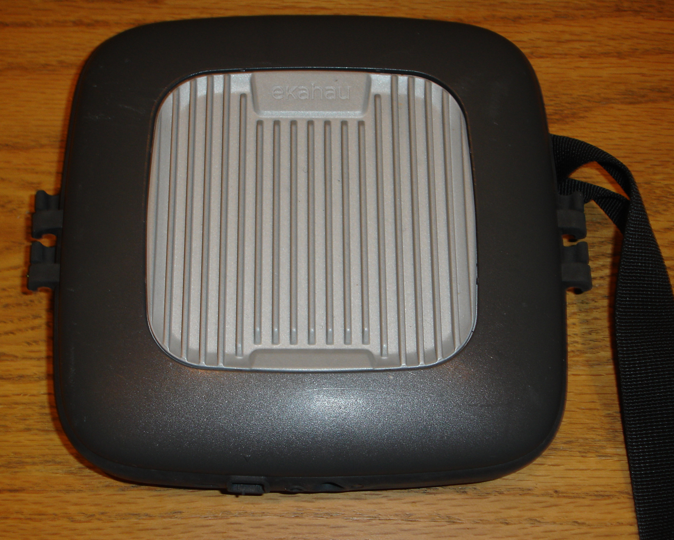
For our surveys we therefore use an Ekahau Sidekick®. To quote Ekahau, the Sidekick® is a professional Wi-Fi device that provides highly accurate and standardised Wi-Fi measurements by using two Wi-Fi radios and a spectrum analyser to achieve expert-level Wi-Fi site surveys and troubleshooting across your network.
The Sidekick® is a battery-powered portable device that attaches to a laptop or mobile device through a USB connection. More control is available with the laptop software, so even though a laptop is not as portable as something like an iPad, we normally use a laptop with the Sidekick® because of the superior flexibility it offers for the design phase over a tablet.
The Sidekick® has universal or omni-directional antennas that ensure that reliable results are obtained (within 4dB) however the Sidekick® is being carried, and regardless of the surveyor's direction of travel. More importantly though, it offers consistent readings over an equivalent range irrespective of the polarisation and the angle of arrival of WiFi signals.
The two dual-band radios allow us to take RF quality measurements across different bands and channels at the same time, this is important because signal readings, which are taken from AP beacon messages, may be affected by interference on a particular channel.
Spectrum Analysis
The spectrum analyser is particularly important because it helps to identify all the non-Wi-Fi traffic that is being received by the internal radios. It sweeps up to 25 times per second on both bands at maximum accuracy, which is faster and more accurate than other instruments designed for this purpose.
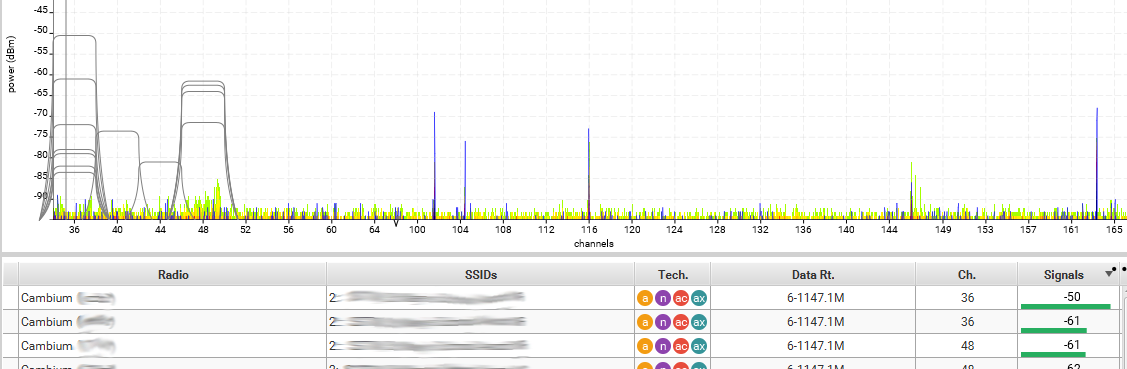
Below is an example of observations taken at an actual site on the 5GHz band. You can immediately see from the grey envelopes, that are being picked up by the Sidekick® radios, that there are lots of APs competiting for bandwidth on channels 36 and 48, instead of being spread across the available channels, which are largely quiet.
We also see some narrow peaks at very specific frequencies, which are shown as vertical lines. The colours of the lines indicate the percentage of the time that that signal is being transmitted. Blacks lines are nearly constant, red represents severe interference, but other colours represent much lower utilisations, although they can still cause problems with Wi-Fi signals, even if they are using up a fraction of the channel
In the example below, these peaks are coming from automated corridor lighting. Each light is beaming out radio waves on a certain frequency and if an object reflects these waves back to the light so it changes the level of signal received, it turn on the lights.
APs may have to avoid these channels, depending on the results of more specific tests.