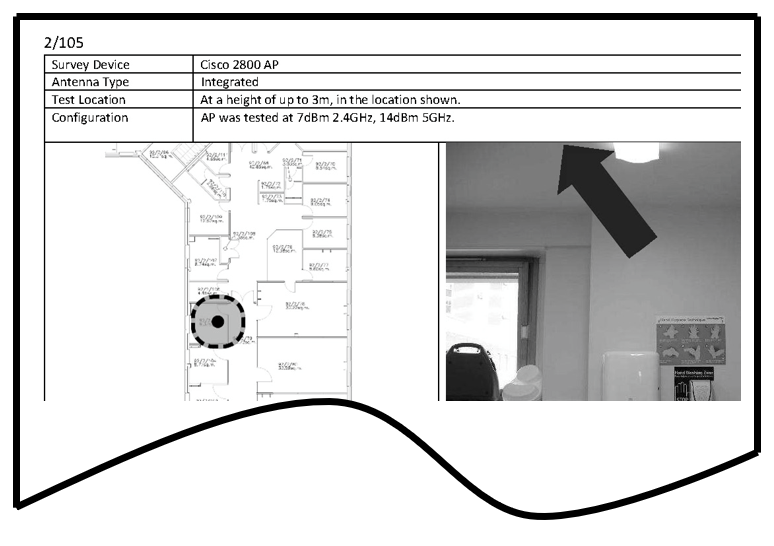
We will agree a bespoke reporting template to document your Wi-Fi design, and the results of any measurements taken during the design process, and afterwards during validation.
This may include reporting roaming and throughput because it is a much more revealing way to test your Wi-Fi network health, than only producing heat maps which may hide other issues with the configuration of the Wi-Fi network that could seriously affect performance.
Various design reporting elements could include:
- Building scope (areas to be covered). NB Any issues with accessibility may require re-testing or a predictive element.
- Client Applications and Device Specification:
- Applications specified
- Channel profile (if measured)
- Power profile (if measured)
- Client capacity requirements
- Results of any client device profiling, including maximum measured throughput and measured roaming performance/behaviour
- Any necessary in-depth observations around client protocol
- The client applications and device specification will allow us to document a design specification that specifies the RF environment to be provided by the APs.
- Highlights of spectrum analysis tests
- Details of any significant interferers/rogues
- Combined AP heatmaps for the design once AP positions and configuration has been tested/confirmed.
- These will include key measurements such as
- Actual measured throughput from client testing,
- AP Signal-to-Noise Ratio from AP (which determines the theoretical maximum throughput),
- AP Signal Strength (which is a component of SNR) and determines the size and shape of each AP cell, and affects roaming,
- AP Contention and Interference (which determines how much of the theoretically bandwidth is available for use)
- Histograms to show the distribution of these parameters across different areas.
- These will include key measurements such as
- AP documentation
- Positions - Recommended and/or actual AP positions depending on customer constraints.
- Configuration - We will provide an explanation of the various AP parameters, and include our recommendations for general parameters.
- Installation instructions
- Options for cabling and mounting
- Any relevant safety observations (such as working at height)
- Existing cable type if relevant
- Estimated cable runs, and lengths to designated comms. cabinet
- Comms cabinet equipment audit/capacity
- AP Specific information
- Mini map, or portion of map showing exact AP position
- Annotated photo showing exact AP position
- Per AP parameters
- AP Model
- Antenna type and configuration
- Mounting type and AP/antenna orientation
- Bands enabled, power levels, recommended initial channel allocation/width (if reqd.)
- Per AP heatmaps across all relevant floors, showing how the coverage of each AP affects each floor. (This can be used with other specific heatmaps to show how well individual AP cells are partitioned or if they affect each other, either complementing each other for roaming, or contending for bandwidth/creating interference on the same channel.
Our health-check and validation reports would be similar except that they would document how well the configuration and installation meets the Wi-Fi design specification.
In this case we also have the opportunity to install our client performance monitoring App., so that soak tests can be undertaken to thoroughly measure the performance of the Wi-Fi from that all important perspective, the user devices themselves.